
Unexpected compressor downtime can disrupt unloading schedules and take a truck out of productive service. Many of the conditions that can contribute to those interruptions can be identified through routine inspection before they become larger maintenance concerns. 

The CycloSaver Preventive Maintenance Checklist gives qualified operators and maintenance personnel a clear schedule for checking critical areas of the compressor, including the air filter, gearcase oil, relief valve, check valve, pipework, silencers, and mounting points.

Instead of waiting for a performance problem to appear during an unload, the checklist helps maintenance teams build these inspections into daily, monthly, annual, and operating-hour-based service intervals. 
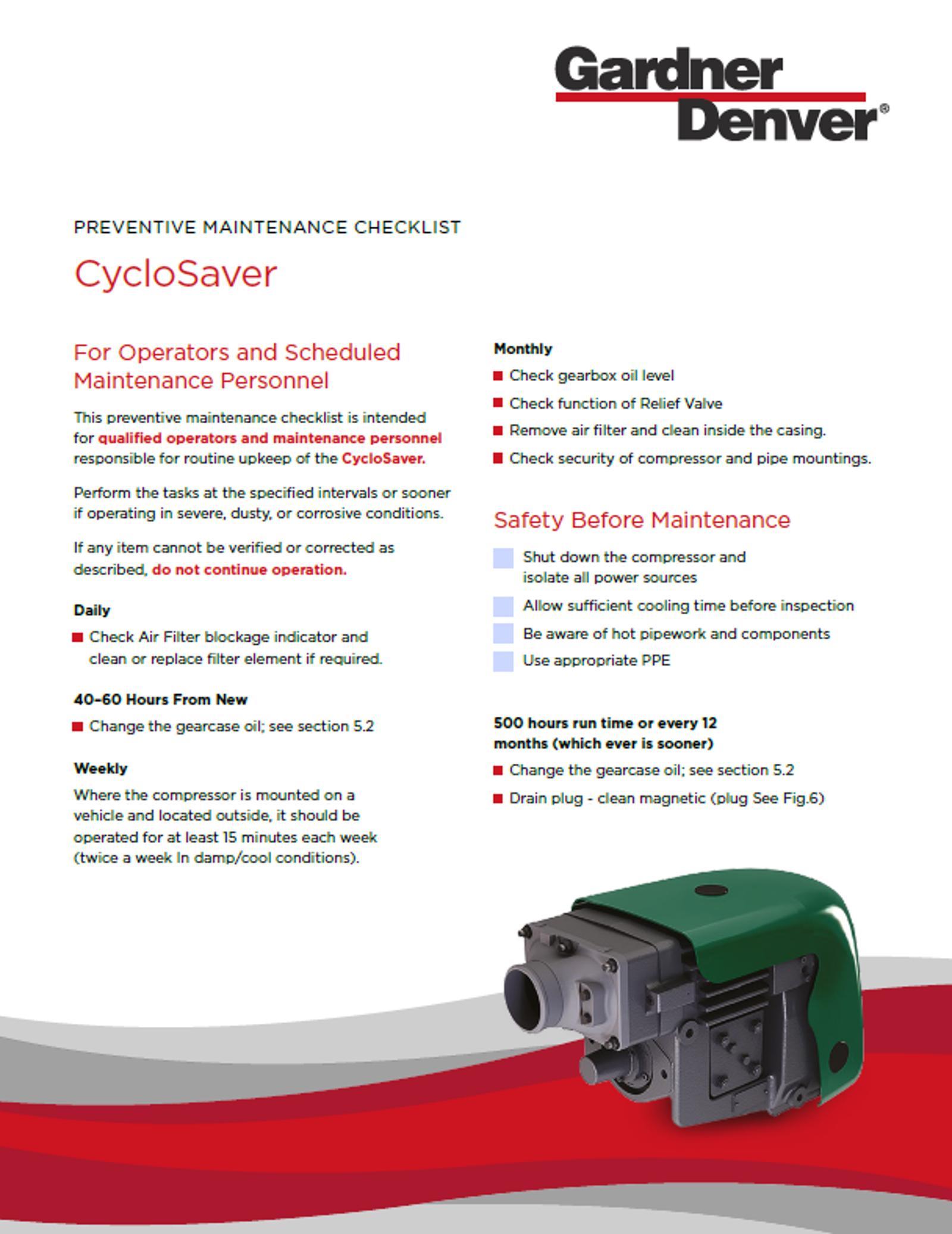
CycloSaver Preventative Maintenance Cover

CycloSaver Preventative Maintenance

The resource combines a preventive maintenance schedule with maintenance procedures and inspection guidance for qualified operators, maintenance technicians, and service personnel. 

It covers: 

  • Daily, weekly, monthly, and annual inspection requirements
  • Initial 40 to 60 operating-hour service
  • 500-hour and 12-month maintenance requirements
  • Gearcase oil changing procedure
  • Check valve inspection
  • Silencer and pipework corrosion inspection
  • Relief valve functional checks
  • Conditions that require the CycloSaver to be removed from service

Maintenance should be performed at the specified intervals or sooner when the CycloSaver operates in severe, dusty, or corrosive conditions. 

Turn Preventive Maintenance Into a Schedule, Not a Reaction

A maintenance program becomes easier to manage when operators know what needs attention and when.

The CycloSaver schedule separates routine inspections by operating interval so that simple checks can become part of normal equipment operation while more involved maintenance can be planned ahead. 

Product Photo Interior Cyclosaver V1

Maintenance Interval 

CycloSaver Maintenance 

Daily 

Check the air-filter blockage indicator. Clean or replace the air-filter element if required. 

40-60 Hours From New 

Change the gearcase oil. 

Weekly 

For vehicle-mounted or outdoor installations, operate the compressor for at least 15 minutes each week. Operate twice weekly in damp or cool conditions. 

Monthly 

Check gearbox oil level, relief-valve function, air-filter casing cleanliness, and security of compressor and pipe mountings. 

Every 3 Months 

Operate the relief valve to clear the valve seat and confirm proper function. 

500 Hours or 12 Months 

Change gearcase oil and remove and clean the magnetic drain plug. Whichever interval occurs first applies. 

Annually 

Inspect check-valve internals, pipes and silencers for corrosion, replace the air-filter element, and inspect relief-valve function, setting, and condition. 

Important: 500 operating hours is the maximum gearcase oil-change interval. 

Don’t Overlook the First Oil Change

Routine oil changes are important, but a new CycloSaver has an additional service requirement. 

The gearcase oil should be changed after the first 40 to 60 operating hours. 

After the initial service, gearcase oil should be changed every 500 operating hours or 12 months, whichever occurs first. 

The maintenance procedure specifies approximately 1.5 litres (3.2 pints) of oil when refilling the gearcase. Oil is added until it reaches the fill-level hole.

During an oil change, qualified maintenance personnel should also remove and clean the magnetic drain plug before reinstalling it with the sealing washer.

Used oil should be collected in a suitable container and disposed of in accordance with applicable environmental requirements. 

Inspect More Than the Compressor

Preventive maintenance shouldn’t stop at the CycloSaver itself. 

The condition of valves, pipework, silencers, filters, and mounting points can also affect whether the system is ready for operation. 


Check Valve 

The check (non-return) valve should be removed and visually inspected for wear, damage, or contamination. 

If there is any doubt about the condition of the valve, the maintenance guidance calls for replacement of the entire valve. New gaskets may also be required during reinstallation. 


Silencers and Pipework 

Inspect silencers and pipework for damage and corrosion. 

Where paintwork has been damaged, corrosion should be cleaned away, treated with rust inhibitor, and repainted as required. Replacement paint must be capable of withstanding temperatures up to 180°C (356°F). 


Relief Valve 

The relief valve isn’t something to check only during annual maintenance. 

Operate it every three months to clear the valve seat and confirm proper function. 

During the annual inspection, check relief-valve function, verify its setting, and visually inspect its condition.

Know When Maintenance Becomes a Stop-Operation Decision

One of the most important purposes of preventive maintenance is recognizing when equipment should not be returned to operation. 

Stop operation and do not return the CycloSaver to service when inspection identifies conditions including: 

  • Oil contamination
  • Valve malfunction
  • Corrosion affecting equipment integrity
  • Leakage
  • Abnormal noise
  • Abnormal vibration
  • Excessive heat
  • Repeated relief-valve activation
  • Required maintenance that cannot be completed as specified

Continuing to operate when an inspection cannot be satisfactorily completed can turn a maintenance concern into a larger equipment problem.

Safety Comes Before CycloSaver Maintenance

Before beginning maintenance, shut down the compressor and isolate all power sources. 

Allow sufficient time for the equipment to cool before inspection. Pipework and compressor components can remain hot after operation, so appropriate PPE should be used. 

The checklist is intended for qualified operators and maintenance personnel. More detailed procedures and corrective work should be performed by appropriately qualified service personnel.

A Simple Maintenance Routine Can Protect Your Unloading Schedule

Preventive maintenance is most valuable when it becomes part of normal fleet operation rather than something performed only after equipment performance changes.

Daily air-filter checks can identify restrictions. Monthly inspections put oil level, relief-valve operation, mounting security, and filter condition on a predictable schedule. Operating-hour intervals make oil servicing easier to plan, while annual inspections provide an opportunity to examine components such as the check valve, silencers, and pipework more closely. 

Together, these checks give operators and maintenance teams a repeatable way to monitor CycloSaver condition and identify concerns before the next unload.

Country

Your request will be forwarded to the relevant individuals to assist with your request.
By clicking 'Send' you are authorizing Gardner Denver to contact you so that we may fulfill your request, as well as to communicate with you regarding our products and services.
Terms and Conditions
Privacy Policy

(* required fields)

This site is protected by reCAPTCHA.

Frequently Asked Questions

Change the gearcase oil after the first 40 to 60 operating hours on a new unit. After that, change it every 500 operating hours or every 12 months, whichever occurs first. The source specifies 500 hours as the maximum oil-change interval. 

Reach Out to Us