
Aeration drives most of the energy use in industrial wastewater treatment, so the blower system becomes one of the highest‑impact decisions a plant can make. When airflow drifts from what the process needs, biological stability drops, energy use climbs, and operators spend more time troubleshooting.

Pre‑engineered blower packages from Gardner Denver support these workloads with stable airflow, predictable performance, and straightforward installation. Facilities use these packages to handle aeration, digestion, filtration, and backwash processes without constant adjustment or tuning. 
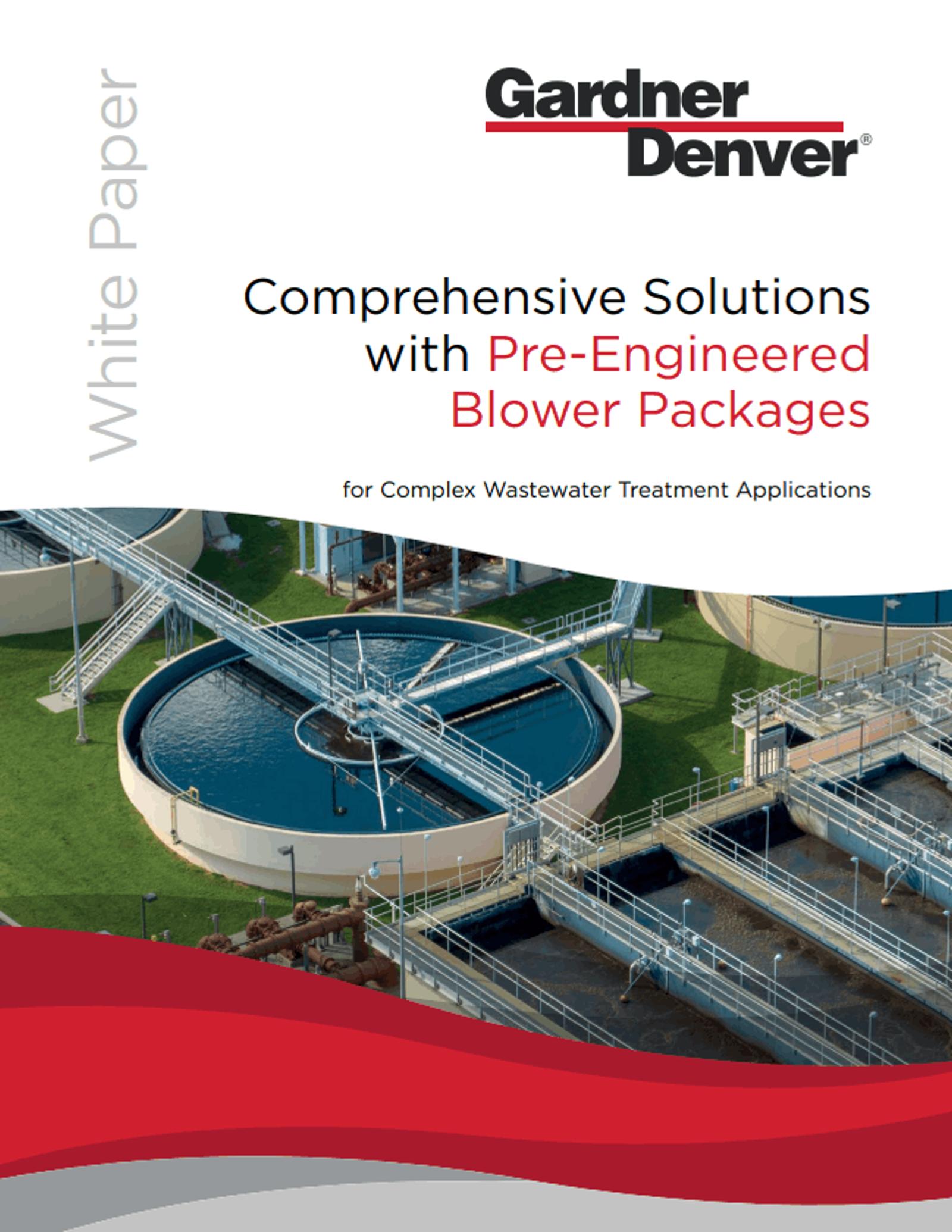
White Paper

Comprehensive Solutions with Pre‑Engineered Blower Packages for Complex Wastewater Treatment Applications

The white paper gives a detailed look at airflow ranges, pressure capability, control options, and energy performance for Gardner Denver’s wastewater blower packages

Comprehensive Solutions with Pre-Engineered Blower Packages Wastewater GD Whitepaper cover

Country

Your request will be forwarded to the relevant individuals to assist with your request.
By clicking 'Send' you are authorizing Gardner Denver to contact you so that we may fulfill your request, as well as to communicate with you regarding our products and services.
Terms and Conditions
Privacy Policy

(* required fields)

This site is protected by reCAPTCHA.

Why Blower Strategy Matters in Wastewater Treatment

Aeration often accounts for most of a plant’s total power use, and blowers typically represent the largest electrical load. When blower output does not match basin demand, operators face higher energy consumption, unstable DO levels, and unnecessary maintenance.

Pre‑engineered blower packages supply steady airflow even as basin conditions change. This stability gives operators fewer reactive adjustments and tighter control of biological performance. 

Positive Displacement Blower Technology for Wastewater Applications

Positive displacement blowers supply constant airflow across variable discharge pressures. This makes them a practical fit for wastewater operations, where hydraulic and biological loads shift through the day. 

Core applications include: 

  • Grit and channel aeration
  • Equalization basin aeration
  • Aerobic digestion air supply
  • Anaerobic digestion gas handling
  • Sand filter and media backwash air

This consistency supports stable dissolved oxygen, predictable solids separation, and steadier nutrient removal. 

Standardized Blower Packages for Wastewater Treatment

Pre‑engineered packages help wastewater teams reduce engineering effort and speed up installation. Each package is designed for specific flow and pressure ranges. 

IQ Blower Package 

  • Up to 1,500 cfm
  • Up to 15 psig
  • Compact footprint with controlled, predictable output

IQ‑RB Blower Package 

  • Up to 5,500 cfm
  • Up to 15 psig
  • Fixed‑speed tri‑lobe blower design for steady continuous duty

IQ‑HE Blower Package 

  • Up to 5,625 cfm
  • Up to 36 psig
  • Screw blower technology for high‑pressure and high‑efficiency aeration

These standardized designs support repeatable specifications and help teams move from design to commissioning with fewer changes. 

Reducing Energy Use Through Smarter Airflow Control

Aeration often drives most of a facility’s energy bill. Blower output that constantly runs at a fixed setpoint leads to unnecessary consumption during low‑load periods.

Pre‑engineered blower packages can support control strategies that adjust airflow to real‑time oxygen demand. When airflow matches what the basin needs, teams cut energy use, avoid excess aeration, and maintain steadier DO targets.

Controller options from Gardner Denver allow operators to supervise multiple blowers, adjust setpoints, track performance trends, and manage alarms. This helps teams maintain reliable airflow with less manual oversight. 

Flexibility to Support Future Expansion

Wastewater treatment rarely stays static. Influent volumes shift, production cycles change, and environmental targets evolve. Modular blower packages allow facilities to increase capacity without redesigning entire aeration or digestion systems. 

Plants often use this approach to: 

  • Expand airflow ranges as treatment loads increase
  • Deploy standardized equipment across multiple sites
  • Build a base for future automation and monitoring improvements

This flexibility supports long‑term planning and helps teams manage capital budgets over time. 

Matching Blower Technology to Treatment Goals

Different blower technologies align with different treatment goals. 

Rotary lobe blowers: Simple construction and steady operation for grit aeration, channel aeration, and general wastewater applications. 

Twisted tri‑lobe blowers: Lower pulsation and reduced sound output for areas with acoustic limits or sensitive structures. 

Screw blowers: Smooth internal compression, lower mechanical wear, and strong efficiency performance for high‑demand aeration. 

Selecting the right technology depends on airflow and pressure needs, efficiency priorities, noise limits, and total lifecycle cost. 

Get the Full Picture

The white paper covers energy performance, maintenance strategy, variable flow requirements, and modular system design. 

Country

Your request will be forwarded to the relevant individuals to assist with your request.
By clicking 'Send' you are authorizing Gardner Denver to contact you so that we may fulfill your request, as well as to communicate with you regarding our products and services.
Terms and Conditions
Privacy Policy

(* required fields)

This site is protected by reCAPTCHA.

Frequently Asked Questions

They supply constant airflow across variable discharge pressures, which supports stable oxygen transfer even as basin conditions shift. 

Reach Out to Us

Find a Distributor